what do you want to know about scoliosis
Scoliosis tin can bear upon children of all ages and tin have particularly severe furnishings when information technology develops early or in association with some other medical condition. If the condition progresses and becomes severe, it tin cause pain, make physical activities harder and limit lung capacity.
When humans evolved to walk on two legs, we developed a curve in our lower dorsum to residuum our trunk and another in our neck to balance our head, to enable forward vision. But sometimes the spine develops an additional, sideways curve that can't exist fixed by simply sitting upward straighter. This is known as scoliosis, a word derived from the Greek "skolios" meaning "curved".
A scoliosis looks uneven and usually takes one of two shapes. A "C" curve bends to just i side, whereas an "S" curve bends outset one way and so the other, so the spine is more balanced overall. I shoulder blade may appear more than prominent if the spine also rotates as a effect of the scoliosis.
Causes and diagnosis
The status has many known causes: a structural aberration in the vertebrae or ribs (congenital scoliosis); in association with a childhood syndrome that has a particular pattern of symptoms and may include scoliosis (syndromic scoliosis); or an underlying nerve or muscle condition that leads to poor command of the muscles of the spine (neuromuscular scoliosis).
Atmospheric condition associated with scoliosis include cerebral palsy, genetically caused disorders such every bit Rett syndrome or ane of the neuromuscular disorders such as Duchenne Muscular Dystrophy.
But virtually scoliosis is "idiopathic", meaning in that location's no known cause for it, although some enquiry suggests a genetic link. Nigh idiopathic scoliosis occurs in adolescents, especially girls. While not yet wholly understood, it's unremarkably estimated that approximately 2% of girls volition develop a scoliosis that requires monitoring.
Sometimes, idiopathic scoliosis occurs in children between two and x years of age (known every bit juvenile idiopathic scoliosis). This affects boys more girls. More rarely, idiopathic scoliosis develops in even younger children and a mother is usually able to feel the spinal curve early on when cuddling her baby.
Scoliosis can as well develop during machismo – for case, with arthritis in the spine or sometimes after a spine fracture due to osteoporosis.
The status usually develops slowly and early on symptoms are subtle; the spine may start to wait uneven and the kid may develop a lean or a limp.
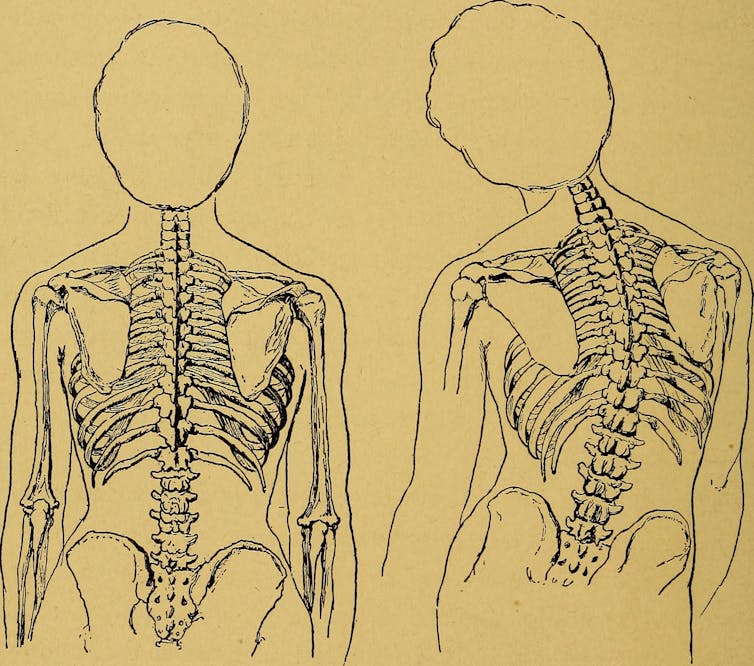
For diagnosis, a forrad bending test is used to observe the spine. If one side of the rib cage lifts while the child is bent, then he or she is probable to accept scoliosis. When doctors suspect scoliosis is developing, they will request an X-ray of the spine and measure the bend.
Impacts and interventions
A small-scale bend is not very noticeable and volition almost likely have trivial impact on health. A curve that progresses into a more astringent shape can have serious wellness impacts. Information technology can crusade pain, make sitting and walking more hard and eventually affect respiratory chapters every bit the lungs have less room to expand.
Screening programs are conducted in only a few countries, including parts of the United states. In other countries like Australia, such programs no longer used for adolescent idiopathic scoliosis, just girls in secondary schools are given a self-detection brochure for families to bank check their spines. If scoliosis is detected, consultation with a general practitioner is recommended.
If a referral is made for specialist treatment, a surgeon will regularly monitor the spine and cheque its impact on daily life. How scoliosis is managed depends on the size of the curve, how fast it is progressing, the historic period of the kid and, of form, the preferences of both the child and their family.
Sometimes the best treatment is but to go on monitoring the curve, while encouraging the child to atomic number 82 the virtually active lifestyle possible. No research to engagement has shown specific spinal exercises to benefit scoliosis.
If the curve is progressing just is not withal very astringent, some surgeons will recommend a brace to foreclose progression. For very pocket-sized children who are more responsive to correction, a surgeon may seek to correct (not just agree) the bend using "serial casting". This involves plaster casts being successively applied to the spine while the child is seated over a period of fourth dimension.
For a very pronounced curve, surgeons may recommend surgery. Spinal surgeons work closely with the child and her parents or guardians to discuss the risks and benefits of surgery. Children who've had a spinal fusion commonly lead active lives after the recovery menstruum and usually go on in their day-to-day activities unaffected.
Scoliosis is a fairly mutual, only non well understood, disorder. As with many areas of wellness, identifying its presentation and development provides the basis for understanding the personal needs of both the afflicted child and family. Clinicians and parents need to be aware of scoliosis and keep an eye on children's spines as they develop.
Source: https://theconversation.com/explainer-everything-you-need-to-know-about-scoliosis-28409
0 Response to "what do you want to know about scoliosis"
Post a Comment